You're qualified on paper
Strong resumes and impressive credentials still aren't enough when you misunderstand what interviews are designed to assess.
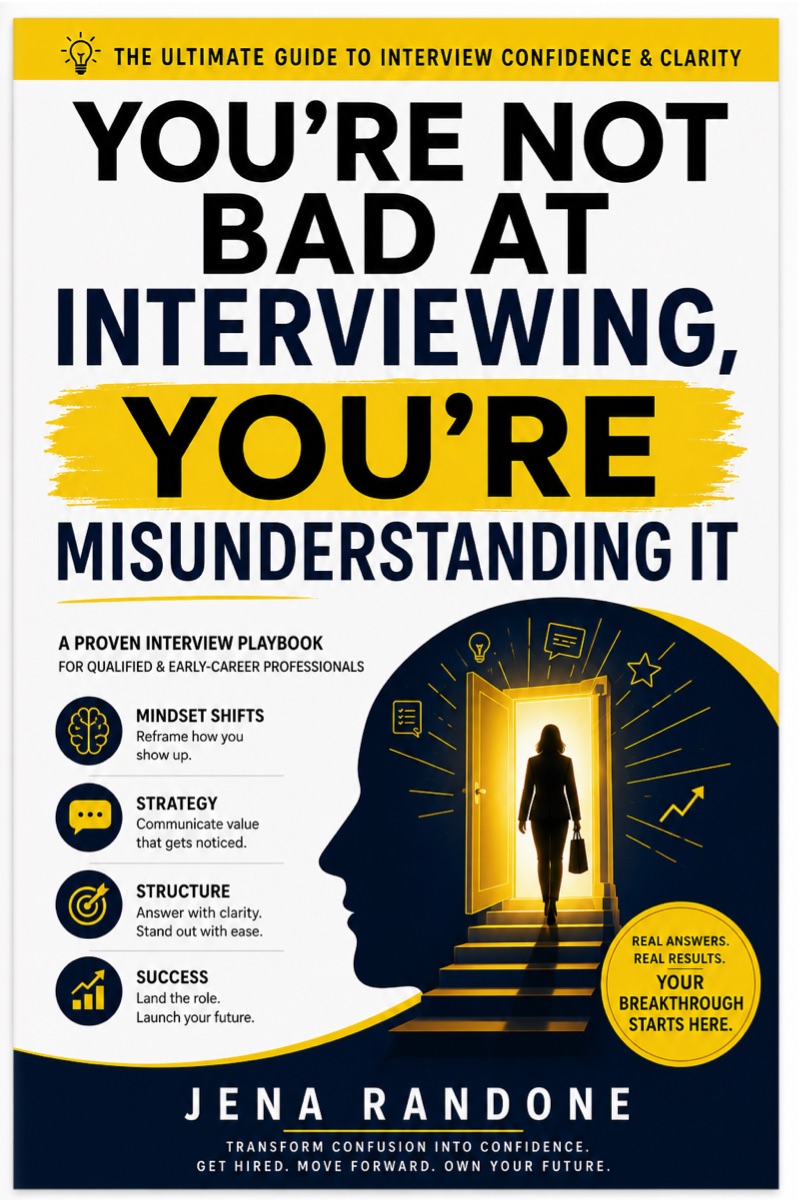
You're Not Bad at Interviewing — You're Misunderstanding It
Job interviews aren't tests of competence — they're assessments of risk. Jena Randone spent 10+ years interviewing at Fortune 100 companies. This is the guide that explains what hiring managers are actually evaluating.
233%
The income growth that came from finally understanding what interviews actually assess — the same framework in this book.
You're qualified. You're trying. But the process still feels opaque — and every rejection without feedback makes the next round harder.
Strong resumes and impressive credentials still aren't enough when you misunderstand what interviews are designed to assess.
They're really assessments of risk — how you think under pressure, how clearly you communicate, and how safe you feel as a hire.
This isn't a list of questions and scripted answers. Memorizing lines won't help you sound clear, confident, and like the right choice.
I've flown across the country for a single 45-minute interview. I've sat through four, five, six rounds for one role — remote calls at 7am before catching a flight, panel interviews in a conference room, case studies, a final round with someone who'd already decided before I walked in. Live or virtual, the evaluation doesn't change — only the setting does. I've learned to read a room, or a screen, in the first ninety seconds of small talk, because that's usually when the real assessment starts, long before anyone asks a "real" question.
I've had multiple offers land in the same week and had to make a life-changing decision in days, not months. I've negotiated salary when I had no leverage and negotiated it again when I had plenty. I've turned down offers that looked good on paper because the fit was wrong, and taken others that scared me. Every one of those rounds — in person or virtual — taught me something the last one didn't. Mostly that the candidates who got offers weren't the most qualified people in the process. They were the ones who stayed calm, sounded certain, and made the hiring manager comfortable saying yes, whether they were across the table or across a screen.
That's what this book is built from. Not theory — countless interview loops, in person and virtual, competing offers with no time to think, and enough decisions made under pressure to know what actually moves the needle.
Jena Randone built her career in pharmaceutical and healthcare sales — one of the most demanding interview environments there is — while also navigating a master's degree and early motherhood, with no industry track record or internal contacts to lean on. Over a decade later, she's been the candidate surviving round five — and she's been the person managers invited into the room to help evaluate others: sitting on panels, weighing referrals, and watching who moved forward and who didn't.
That second view is what most prep never gives you. From inside the process, the gap between the résumé that looked strongest and the candidate who actually got the offer becomes obvious fast — and it usually has less to do with credentials than with how someone comes across under pressure. This book isn't written by a coach who's never had to negotiate their own offer or never sat in a hiring conversation where the decision was already forming in the first few minutes. It's written by someone who did both, repeatedly, and turned what she learned into a method other candidates can actually use.
You're Not Bad at Interviewing — You're Misunderstanding It
How Interviews Really Work — and Why Understanding Them Changes Everything
32 pages · Paperback · ISBN 9798244705683
Get the book before your next interviewA one-page template to walk into any interview — panel, phone screen, or final round — knowing exactly what to say. Enter your email and it's yours.
The right career shouldn't depend on guesswork.
Order on Amazon